
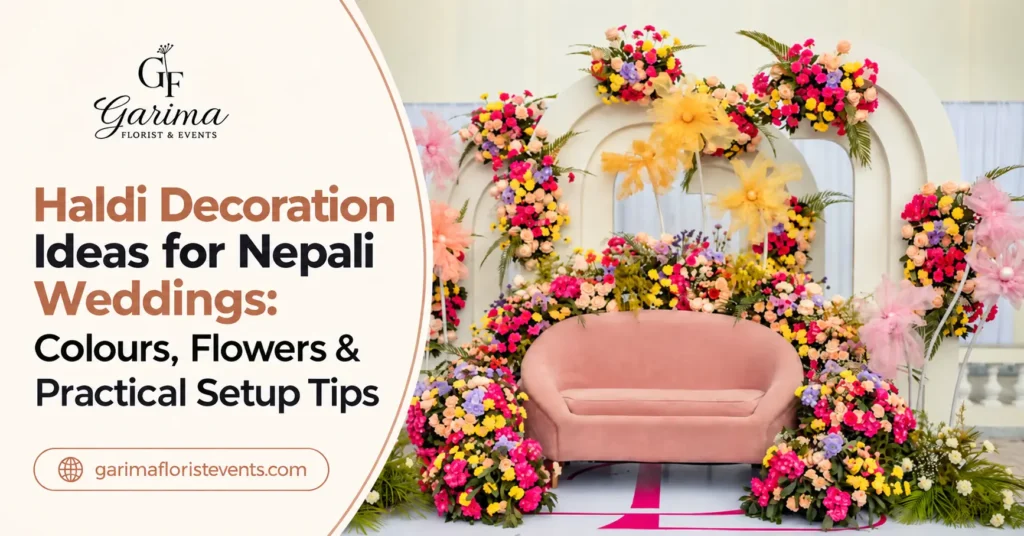
Haldi decoration ideas for Nepali weddings should start with the space you have—not just a backdrop you like. Whether you are planning a ceremony at home, in a courtyard, garden or venue, leave room for seating, family members taking part, photographs and clean-up.
This guide covers simple home setups, floral backdrops, colour combinations and outdoor decoration tips. Start with the ceremony layout, then choose flowers and decorative details that fit. Follow your family’s ceremony arrangements when deciding whether to provide individual or couple seating and how relatives will approach.
Quick Summary: Planning a Haldi Setup
- Choose the space first. Home, venue and outdoor setups each need a different design.
- Build around one clear focal area. Use one main backdrop to keep a compact setup visually clear.
- Keep colors simple. Choose one main colour and one or two supporting tones for a more balanced setup.
- Plan seating early. Decide where the couple sits before you add the backdrop.
- Keep family access open. People need to reach the couple from both sides.
- Check natural light. Look at where daylight falls at the real ceremony time.
- Protect floors and furniture. Turmeric stains easily.
- Prepare for weather outdoors. Shade, wind and rain can change your plan quickly.
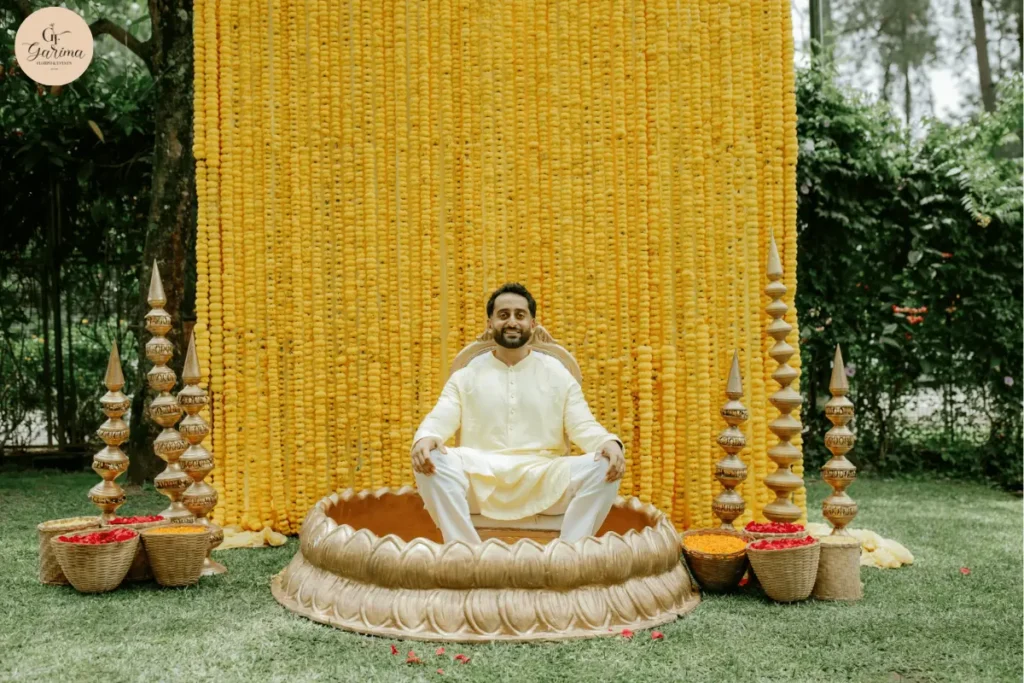
Start With the Space: Home, Venue or Outdoor Haldi ?
Plan the space first, because the space decides the size of your backdrop, the seating, the flowers and the way guests move. A beautiful design can fail in the wrong space. A wide stage backdrop, for example, will crowd a small living room. A simple setup can look lost in a large hall. Measure the area, then choose the design that fits it.
Haldi Decoration at Home
A home Haldi works best with a compact backdrop and one main focal point. Most homes have limited floor area, so a small, well-placed setup is better than a copy of a large venue design. At home, the Haldi may be set up in a living room, courtyard, terrace or garden area depending on the available space.
Here is what to check at home:
- Wall clearance: Leave clearance between flowers and painted walls. Confirm how the backdrop will be supported; wall clearance alone does not make a heavy installation suitable.
- Floor area: Leave space in front of the couple for family members to stand and bend forward.
- Furniture: Move extra chairs and tables out of the way. Cover sofas or cushions you want to keep clean.
- Floor protection: Use a protective covering suitable for the floor, secure the edges, and check that it stays stable underfoot.
- Family movement: Keep one clear path for elders and children.
- Natural light: Choose an area with useful natural light, but avoid harsh direct sunlight or strong back lighting at the ceremony time.
Haldi Decoration at a Venue
A venue gives you more room, so you can use a wider backdrop, larger seating and a separate guest area. You can also add an entry area and a photo corner. However, more space does not mean you should fill it all. Keep the couple’s area as the clear center, and let guests stand or sit around it.
Before finalizing the design, confirm the venue’s setup and dismantling times, delivery access and installation rules. Ask where frames can stand and whether anything may be attached to walls or ceilings. These details affect the backdrop size and how the setup can be installed.
Outdoor Haldi Decoration Ideas and Setup Tips
An outdoor Haldi needs a plan for sun, wind, rain and ground. Gardens and open spaces look fresh in daylight, but weather can change the setup fast. Follow these basics:
- Shade: Midday sun is hard on guests and on flowers. Use a tent, canopy or natural tree shade.
- Wind: Secure fabric, garlands and supporting frames for the conditions. If wind increases, remove loose hanging details or move to the covered backup area.
- Rain: Keep a covered backup area close by. Decide early when to move.
- Ground: Check for uneven grass, mud or slopes. Place seating on a flat, firm base.
- Changing sunlight: For outdoor functions, final placement should be checked against the ceremony time, because the amount of shade and direct sun can change through the day.
Simple Haldi Decoration Ideas for Home Ceremonies and Small Spaces
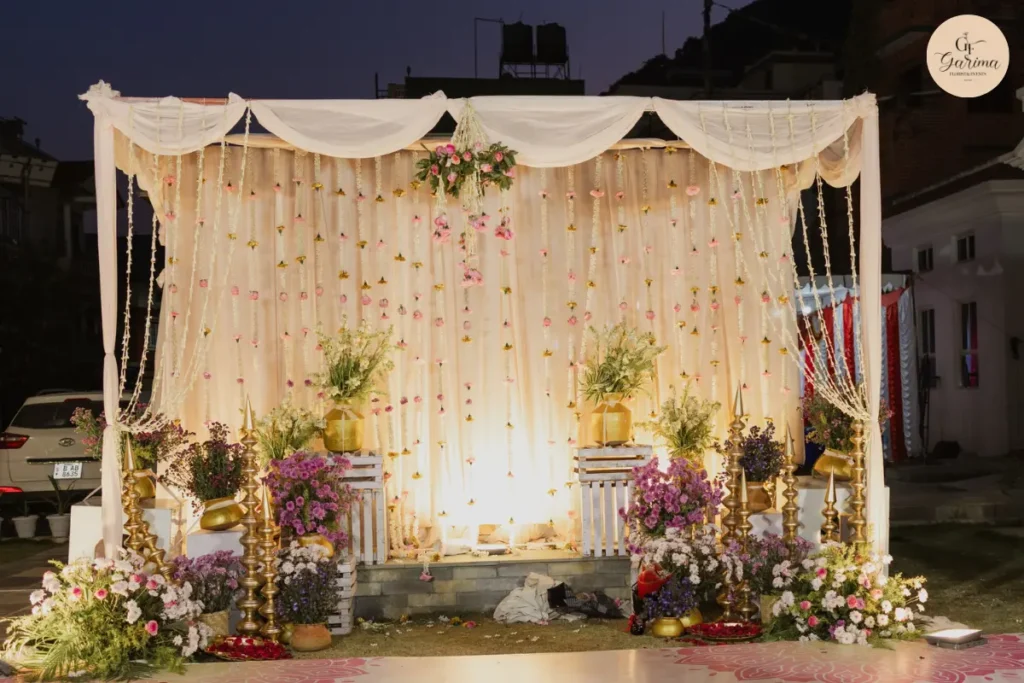
In a small space, use one simple backdrop, a few flowers and clear floor space. A smaller setup is often more practical than a large venue design at home. It leaves room for the ceremony and still looks neat in photos. These simple haldi decoration ideas work well for homes, courtyards and compact halls:
- Simple fabric backdrop: A plain yellow, cream or white cloth hung neatly gives a clean base.
- Marigold garlands: Hang them in strings or along the edges. They add colour without taking much room.
- Compact floral frame: A small frame with flowers on one side or at the top can hold the focus.
- Low or simple seating: A bench, small sofa or low stool keeps the setup light.
- Limited props: Use only a few decorative or ritual items near the focal area so they do not reduce usable floor space.
- One ceremony and photo area: Use the same spot for both, instead of creating many zones.
In short, a small space needs fewer pieces, not smaller versions of everything.
How to Choose a Colour Palette for Haldi Decoration
Yellow is the most common Haldi colour. It looks even better when you add one or two matching colors instead of using yellow everywhere. Pick your palette first, then match the backdrop, flowers, seating and cloth to it. This keeps the whole setup consistent.
Yellow and Marigold Orange
This creates a warm, saturated look and works well with marigold-heavy backdrops and traditional floral styling. Because the colors are close, the result looks rich without feeling messy.
Yellow, White and Green
This combination looks fresh and natural. White flowers and green leaves soften the strong yellow. It suits gardens, courtyards and daytime ceremonies.
Yellow and Pink
Pink adds a festive, cheerful touch. It works well when the couple wants a more colorful look. Use pink in small amounts, such as flowers or cushions, so yellow stays the main colour.
Mustard and Earthy Tones
Mustard with cream, brown or soft orange gives a calm, modern feel. It suits simple homes, wooden furniture and quiet celebrations.
Soft Pastel Haldi Palette
Pale yellow, peach and light green create a gentle, light look. This palette suits bright, airy spaces. In darker spaces, test the palette under the actual lighting because softer colors may appear less distinct.
Flowers That Work Well for Haldi Decoration
You can use flowers heavily or only in a few places. The right amount depends on your space and style. A large venue may need full floral work, while a small home may only need garlands and a few accents.
Marigolds for Haldi Decoration
Marigolds are a familiar choice for Haldi because their yellow and orange tones suit the visual character of the ceremony. They are not compulsory, though. You can use them in many ways:
- Garlands on the backdrop or doorway
- Hanging strings for depth
- Small clusters at the corners
- A border around a fabric backdrop
- Entrance accents
- Small touches on seating
Even a small amount of marigold can create a clear Haldi look, so there is no need to cover every surface.
Mixed Flowers and Greenery
Mixing flowers with greenery makes the setup lighter. Green leaves add contrast to strong yellow and orange. They also reduce the heavy, crowded look of a full marigold wall. This approach suits outdoor and garden settings, where the surroundings already add green.
Fresh vs Artificial Flowers
Fresh and artificial flowers can serve different purposes. In prominent areas where natural texture matters, fresh flowers are preferred. The right mix depends on the design, ceremony duration, weather and availability.
Confirm Flower Availability Before Finalizing the Design
Flower availability can change with the season, so it is better to keep some flexibility in the floral plan. For Haldi setups, Garima commonly works with marigolds, roses and carnations, depending on availability and the overall colour palette. Artificial flowers can also be used where fresh flowers are less practical or when the design requires longer-lasting coverage.
Confirm your preferred flowers before approving the design, and agree on substitutes in similar colors. If a flower is unavailable, a mix of fabric, greenery and selective floral accents can help preserve the overall look.
If you want to explore how flowers, backdrops and styling are planned together, see Garima’s floral and decor design page.
Haldi Backdrop Ideas for Different Spaces
Choose a backdrop by checking three things: who it is best for, how much space it needs and what could go wrong. The ideas below follow that pattern, so you can match them to your own space.
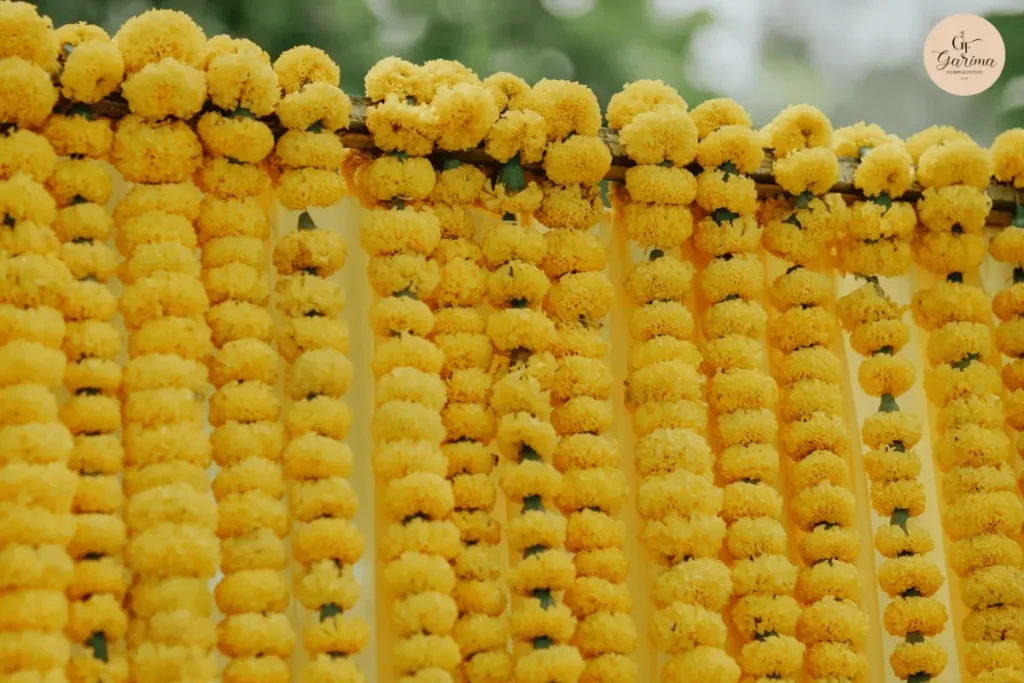
Marigold Garland Backdrop
Best for: Traditional or simple setups.
Space needed: Small to medium. A light frame and hanging strings need little depth.
Practical consideration: Use fixings approved for the wall or supporting frame, and keep hanging garlands clear of the seated participants.
Fabric and Floral Backdrop
Best for: Homes or venues that need a soft background.
Space needed: Small to medium.
Practical consideration: Fabric should be tensioned and positioned carefully because folds, seams and uneven draping become very visible in wide photographs.
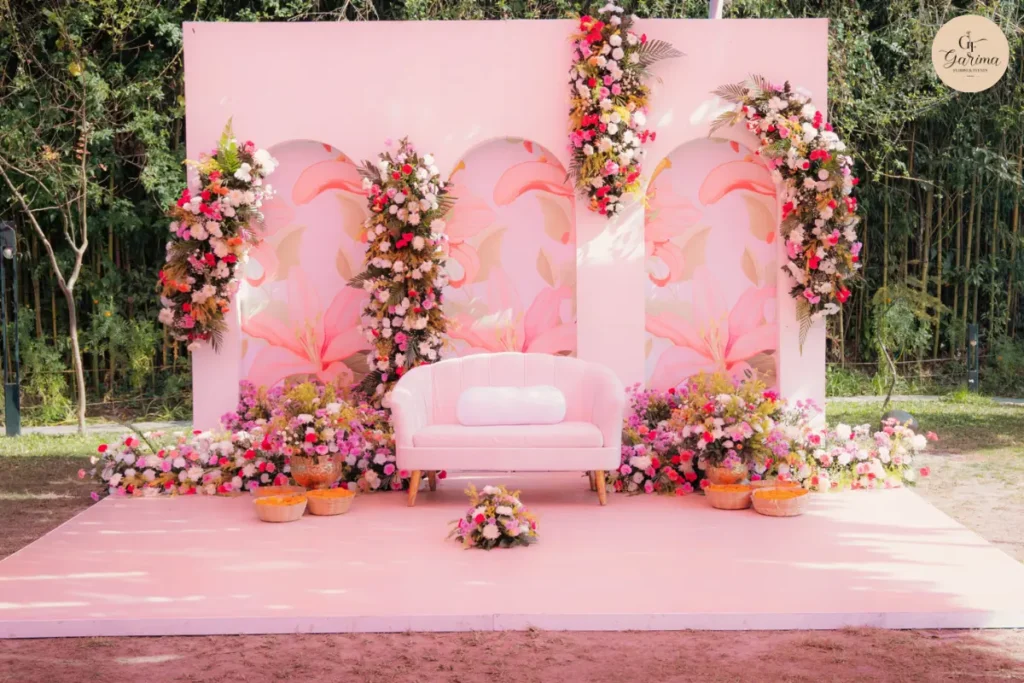
Floral Arch or Frame
Best for: Medium to large ceremony areas.
Space needed: Medium to large. Leave room on both sides.
Practical consideration: Make the frame wide enough to show the couple clearly, but not so wide that it blocks family access or the photographer.
Greenery-Based Backdrop
Best for: Gardens and outdoor Haldi.
Space needed: Medium.
Practical consideration: Yellow or warm floral accents can be added if you want a stronger Haldi identity against the greenery.
Minimal Haldi Backdrop for Small Homes
Best for: Simple haldi decoration at home.
Space needed: Small. A narrow wall or corner is enough.
Practical consideration: Use a lightweight frame, simple garlands and a little fabric. Skip deep stages, and choose seating that takes little floor space.
Plan the Couple’s Seating Before Adding More Decoration
Fix the couple’s seating first, because family members need room to approach, apply Haldi and step away. Seating decides how people reach the couple, where guests stand, where the photographer works and how large the backdrop should be. A practical sequence is: seating → ceremony access → guest movement → photography → backdrop scale.
Consider these points:
- Seating type: A sofa, bench, low stool or floor cushions can all work. Pick what suits the couple and the family.
- Seating height: Very low seating may be difficult for some elders to access, while very high seating can make family interaction less comfortable during the ceremony.
- Access from both sides: Do not push the seating against a wall or a wide frame.
- Space for bowls and trays: Keep a small table or mat nearby for turmeric paste and ritual items.
- Photographer line of sight: Make sure the camera can see the couple without a flower stand in the way.
- Backdrop proportion: Match the backdrop width to the seating, not the other way round.
Leave Enough Space for Guests, Family and the Photographer
A good Haldi layout lets family members reach the couple easily and lets guests watch without crowding. Think about how people will actually move. Elders may need a short, clear path and a seat nearby. If children are present, keep tall stands, loose cables and lightweight props away from the main movement area.
Follow these simple rules:
- Keep one clear walkway to the couple.
- Give the photographer a spot with a view and room to move.
- Mark a standing area for guests so they do not block the ceremony.
- Avoid clutter, such as extra stands, baskets and props.
- If the space allows, separate the main approach path from the area where guests leave the ceremony zone.
Good guest flow is part of event planning, not just decoration. In practice, small layout decisions—where the couple sits, where guests wait, and where the photographer stands—can affect the function as much as the decorative elements. One common issue in Haldi functions is crowding around the couple, especially when decorative stands, seating or photo areas reduce the available movement space. Keeping a clear approach path and enough open space around the ceremony area helps the function run more smoothly. This is one reason why planning wedding functions involves coordinating layout, timing and guest movement alongside the decoration.
Use Natural Light When Positioning the Haldi Backdrop
Check where daylight will fall at the actual ceremony time before you fix the backdrop position. Light in the morning is different from light at noon or in the afternoon. A spot that looks perfect at 9 a.m. may be in harsh sun at midday.
Keep these points in mind:
- Direct sun: It can make the couple squint and create strong, harsh shadows.
- Back-lighting: If the window or sun is behind the couple, faces can look dark in photos.
- Shade: Soft, even shade is often easier to work with outdoors because it reduces harsh shadows.
- Canopy shadows: A tent can cast dark patches. Check them before you place the seating.
- Colour: Check fabric and flower colors under the lighting you will actually use; their appearance can change between daylight and indoor lighting.
If possible, check the space at roughly the same time of day as the ceremony. This simple step saves a lot of rearranging later.
You can also view some of Garima’s wedding and event work to see how different spaces, floral styles and layouts have been approached in real projects.
Flooring, Stains and Clean-Up: What People Often Forget
Plan for the mess the ceremony creates, not only for how the setup looks in photos. Turmeric stains cloth, carpet and walls. Water and petals can also make a smooth floor slippery. This matters most at home, where floors, walls and furniture are often not made for stains.
Protect your space with these steps:
- Cover carpets and rugs with a plain sheet or protective floor covering suitable for the surface, with a clean mat or cloth layer above it.
- Protect sofas and upholstery, or choose seating that is easy to wipe.
- Keep decorations away from nearby walls, or cover the wall area.
- Keep basic clean-up materials nearby so spills can be handled quickly.
- Put bowls and trays on a stable base so they do not tip.
- Watch for wet or smooth floors, and keep a dry mat at the edges.
- Check that you can reach the area easily with cleaning supplies after the ceremony.
- Cover rented furniture first, since stains can lead to extra charges.
Simple vs More Detailed Haldi Setups: What Changes?
A simple setup keeps one focal area, while an elaborate setup adds more zones, flowers and lighting. Both can work well. The better choice depends on your space, guest count and the way you plan to use the area.
| Element | Simple Haldi Setup | Elaborate Haldi Setup |
| Backdrop | Small floral or fabric focal point | Large custom installation |
| Flowers | Selective accents | Dense floral styling |
| Seating | Simple couple seating | Fully styled lounge |
| Photo area | Ceremony backdrop doubles as photo area | Separate photo zone |
| Entrance | Minimal styling | Coordinated entrance design |
| Lighting | Natural or existing light | Added decorative or event lighting |
| Space needed | Small to medium | Medium to large |
DIY Haldi Decoration vs Professional Setup: Which Is Better for You?
A DIY Haldi setup can work well for a small home ceremony with a simple backdrop, limited flowers and enough preparation time. Professional support may be more practical when the setup involves a larger venue, custom structures, detailed floral work, outdoor conditions or a short installation window.
| Factor | DIY Haldi Decoration | Professional Setup |
| Best suited to | Small, simple home ceremonies | Larger or venue-based setups |
| Time needed | More family preparation and hands-on setup | Less setup work for the family |
| Backdrop | Simple fabric, garlands or lightweight frames | Larger or custom structures |
| Flowers | Limited, simple floral work | More detailed floral installations |
| Venue coordination | Managed by the family | Can be coordinated with venue requirements |
| Outdoor setup | Better for simple arrangements | Useful when weather or installation is more complex |
Before deciding, consider the space, setup time, venue restrictions and complexity of the decoration.
What Should You Priorities If Space or Budget Is Limited?
When space or budget is tight, focus on comfort first and decoration second. Follow this order:
- Comfortable couple seating and ceremony area
- One strong backdrop
- Flowers around the focal point
- Clear guest movement
- Extra photo or entrance decoration only if it helps
One well-planned focal point usually works better than decorating every corner. It looks cleaner, it is usually easier to install, use and manage during the ceremony.
Common Haldi Decoration Mistakes to Avoid
Avoiding a few common planning mistakes can make your Haldi setup feel more comfortable, organized and visually balanced on the day.
Choosing a backdrop before measuring the space
Measure the width, height and depth first. A backdrop that is too big blocks movement, and one that is too small looks lost.
Using too many colors
Stick to yellow plus one or two supporting colors. Too many colors make the setup look busy.
Blocking family access
Do not place props, stands or large flowers where family members need to stand. Keep both sides of the couple open.
Ignoring floor and furniture protection
Turmeric can stain fabrics, upholstery and some surfaces, so protection should be planned before the ceremony.
Positioning the backdrop without checking light
Visit at the real ceremony time. Move the setup if the sun or shadows cause trouble.
Planning outdoor decoration without a weather backup
Identify a covered backup area and decide in advance when the setup would need to move if weather changes.
Decorating every area instead of prioritizing one focal point
Put your effort into the couple’s area first. Add extra pieces only when space and time allow.
Questions to Answer Before Finalizing Your Haldi Setup
Use this checklist with your family and decorator:
- Will the Haldi be at home, in a hotel, in a garden or at another venue?
- Is it indoor or outdoor?
- How many guests will come?
- What time does the ceremony start?
- How much setup space do you have?
- Which colors do you prefer?
- Which flowers do you like?
- What couple seating style do you want?
- Will the ceremony area also be the photo area?
- Does the flooring need protection?
- Do you have a weather backup?
- How early can the decorator enter the space?
- Are there any loading, lift, staircase or access restrictions at the venue?
What Garima Checks First
Before planning a Haldi backdrop or ceremony area, Garima first looks at the venue, expected guest count, ceremony timing, decoration ideas and practical requirements of the setup. These details help decide the right backdrop size, seating position, floral coverage and how much space should be kept open for movement.

Planning Haldi Decoration as Part of the Wedding Functions
Haldi is usually one part of a larger wedding programmed, so its setup should fit the rest of the schedule. Timing, venue, guest movement, decoration and coordination all affect each other. If venue access starts late or setup takes longer than expected, the ceremony schedule can become compressed.
That is why setup timing should be confirmed together with the wider wedding schedule. If you are planning your wedding functions, decide the Haldi time and space early. Then match the decoration plan to the rest of your wedding days. For broader ideas, you can also read about event decoration in Nepal.
Some Useful Resources
For more inspiration and planning references, you may also find these useful:
- The Knot — Haldi Ceremony Guide
- WedMeGood — Haldi Ceremony: Rituals, Decor & More
Frequently Asked Questions
What are some simple Haldi decoration ideas at home?
Use one focal backdrop, a few marigold garlands, compact seating and floor protection. A fabric backdrop with flowers at the edges works well. Keep the rest of the room clear for family movement.
Which colors work best for Haldi decoration?
Yellow is the most familiar base colour for Haldi decoration, but it can be paired with marigold orange, white, green, pink or earthy tones depending on the style of the setup.
Which flowers are commonly used for Haldi decoration?
Marigolds are common, but they are not the only choice. Many setups mix them with other flowers and greenery. The best choice depends on the design, season and what is available.
How can I keep Haldi decoration simple on a limited budget?
Use one fabric backdrop with selective flower accents, reuse suitable seating, and let the ceremony area double as the photo spot. Confirm what you already have before buying or hiring extra props. Keep floor protection and clear access in the plan.
What should I consider for an outdoor Haldi ceremony?
Think about shade, wind, rain, ground stability and how securely the decorative elements can be installed. Protect flowers from strong sun. Always keep a covered backup area ready.
Do I need a separate photo backdrop for Haldi?
Not always. For small or home ceremonies, the main backdrop can work for both the ceremony and photos. Add a separate photo area only if you have the space and guests will use it.
Final Thoughts
The best Haldi setup is not always the largest one. It is the one that fits your space, keeps the couple and family comfortable and supports the ceremony. Start with the space, then plan seating, guest movement and light.
After that, choose colors, flowers and a backdrop that match the function. A simple, well-planned setup often looks better than a crowded one.
Garima Florist & Events has been planning weddings, functions and event setups in Nepal since 2008. You can view the team’s wedding and event work or explore its floral and decor design approach for more examples of how different wedding spaces are planned.